Showing posts with label marsupial lion. Show all posts

Friday, 4 January 2013

Meet the Cryptozoologist: Dr Karl Shuker


How did you first get involved in researching strange and mysterious creatures?
I'd always been interested in the more unusual animals as opposed to the familiar ones, so when I was bought a copy of Bernard Heuvelmans's book On the Track of Unknown Animals as an early teenager by my mother, it sparked what has become an enduring, life-long interest in cryptozoology.

What were some of the early influences in your life?
Heuvelmans, definitely, also my mother, whose own interest in animals and nature immeasurably encouraged and directed my own.

Have you personally seen one of these creatures?
Sadly, no, though the upside of this is that I can remain entirely objective in relation to cryptid cases, not being influenced by personal experience.

What creatures particularly interest you?
Even with cryptozoology, I prefer the lesser-known, less-publicised animals as opposed to the more famous ones, so I have a wide range of interests in this field, including many that until I documented them had not been chronicled within the cryptozoological literature - such as the Scottish earth hound, the Sri Lankan devil bird and horned jackal, a vast diversity of mystery birds, the New Guinea devil pig, and all manner of little-known mystery cats from around the world.

What cryptids are most likely to exist in your opinion?
The two that seem most plausible and also most likely to be discovered at some point are the Sumatran Orang pendek and the Thylacine (though the latter may actually be discovered on New Guinea before/if at all on Tasmania or mainland Australia, if only because New Guinea is far less well-explored).

What’s your favourite?
The Fujian blue tiger has always held a particular appeal for me – the thought that there may have been and may even still be tigers with blue fur seems surreal and yet is backed by very reputable eyewitness reports.

What’s your favourite Australian cryptid?
The Yarri or Queensland tiger. I'd love it to exist and to be a living Thylacoleo (marsupial lion) – that would be an immensely significant cryptozoological revelation if one day confirmed.

Have you developed any theories around where the more unusual animals - i.e. yowies/bigfoot - have come from?
The yowie is definitely an enigma, in terms both of its origin and of its identity. In my book In Search of Prehistoric Survivors, I discussed the lesser-known theory that it may actually be a marsupial, possibly a surviving unusually primate-like diprotodont, which would certainly make sense zoogeographically. If a genuine placental primate, however, it might have arrived in Australia by rafting from south-east Asia. Indeed, although not widely known, there is even a very yowie-like entity reported from New Guinea, so perhaps yowies crossed the Torres Strait from there into Australia.


Have you written any books/articles?
Eighteen books to date, hundreds of articles, and I've been consultant and/or contributor to ten other books, so I've kept myself busy since I began writing in the mid-1980s! My most recent book is Cats of Magic, Mythology, and Mystery (CFZ Press: Bideford, 2012), published in December 2012, which contains a lot of information concerning Australasian examples.

Do you have a website?
My official website is at www.karlshuker.com and I also have my award-winning blog, ShukerNature, at www.karlshuker.blogspot.com, which contains nearly 300 articles on a very diverse range of subjects appertaining to cryptozoology and (un)natural history.

How many mystery animal reports would you receive a year?
Lots! I've never actually counted them, but it has to be in the hundreds.

What’s the closest you’ve personally come to finding something?
I spotted two unusually large quails on the New Zealand island bird sanctuary of Tiritiri Matangi when holidaying in Auckland in 2006, which I later read may actually be surviving specimens of the supposedly long-extinct and fairly large native New Zealand species of quail (quails living in New Zealand today are all supposed to be the smaller naturalised Australian quail). When DNA studies of these oversized Tiritiri quails (also spied by others there over the years) were carried out, however, they revealed that the quails were not New Zealand quails after all, sadly.

What’s the farthest you’ve traveled to go ‘in search of’ mystery animals?
I've travelled all over the world, to every continent except Antarctica, and to locations as isolated as Easter Island in the mid-Pacific (which is about as remote as anywhere on the whole of planet Earth, in fact), and I've always combined holidays with mystery beast investigations on-site whenever possible.

What’s next for you - any trips planned? Books or articles to write? 
Talks to give?
All three, hopefully – certainly, more books and articles, from which I earn a living, so it's not just for the fun of researching and writing them, though I do definitely derive immense pleasure from that.


Could you share some of your favourite cryptozoology book titles with us?
Heuvelmans's On the Track of Unknown Animals will always be #1 on the cryptozoological bookshelf for me, but nowadays there are so many others that we're spoilt for choice. Obviously, however, I definitely favour Michael Newton's massive Encyclopaedia of Cryptozoology, and George Eberhart's hefty 2-volume counterpart, Mysterious Creatures.

What advice would you give anyone getting into the field of cryptozoology?
Read as much information as possible re: the cryptid that you plan to seek before setting forth into the field – too many crypto-expeditions in the past have set out ill-equipped with knowledge on the animal that they are seeking. Know your cryptid thoroughly, and then you have a decent chance of discovery. A fair time ago, one ill-fated expedition clearly did not do this, because it actually went looking for the cryptid concerned in entirely the wrong country! Incredible but true.

Monday, 7 November 2011

Lion spotted in the Northern Territory

http://en.wikipedia.org/wiki/Lion
The CFZ's Mike Williams talked about all things big cat on ABC radio today in the wake of this intriguing story:

Authorities in Darwin are on the lookout for a feral lioness, after three reports of a big cat being spotted crossing the Stuart Highway.

The sightings late Sunday night sparked a quick police search and a check at Crocodylus, a local wildlife park just  a few minutes from the scene.

According to the NT News, three cars pulled over while the animal crossed the highway in front of them at Pinelands, a small suburb about 20km from Darwin.

''I often get reports of dingoes in the area, which are a similar colour but a completely different size,'' said a spokeswoman for NT Police.

Police found no trace of the creature.

Chief scientist at Crocodylus, Charlie Manolis, told AAP he took the sightings seriously, but both lions at the park were found to  be secure.

He said that ''not in a gazillion years'' could a lion have  escaped its enclosure and then voluntarily returned and been present when checked.

Manolis said because three different people had reported seeing a lion, it was likely something was roaming around.

''Whether there is a large dog or a beastie out there that looks like a lion, we would like to find out any information about what  it really is,'' he said.

Crocodylus is the only wildlife park in the Northern Territory that houses lions.

http://www.ntnews.com.au/article/2011/11/07/271141_ntnews.html

Flashback: A lioness escape documented in 1986 in the Northern Territory.  

Thursday, 25 November 2010

Bad luck not bad genes ended Thylacoleo's reign


Marsupial predators are not the poor cousins of the carnivore world, as has long been thought: new research shows that they have been just as diverse as placental carnivores over time.

"We've looked at the deep-time perspective and shown that over evolutionary history marsupial carnivores have been every bit as varied in shape and habit as their placental counterparts," says Dr Stephen Wroe, an author of a paper published in the journal Proceedings of the Royal Society B.

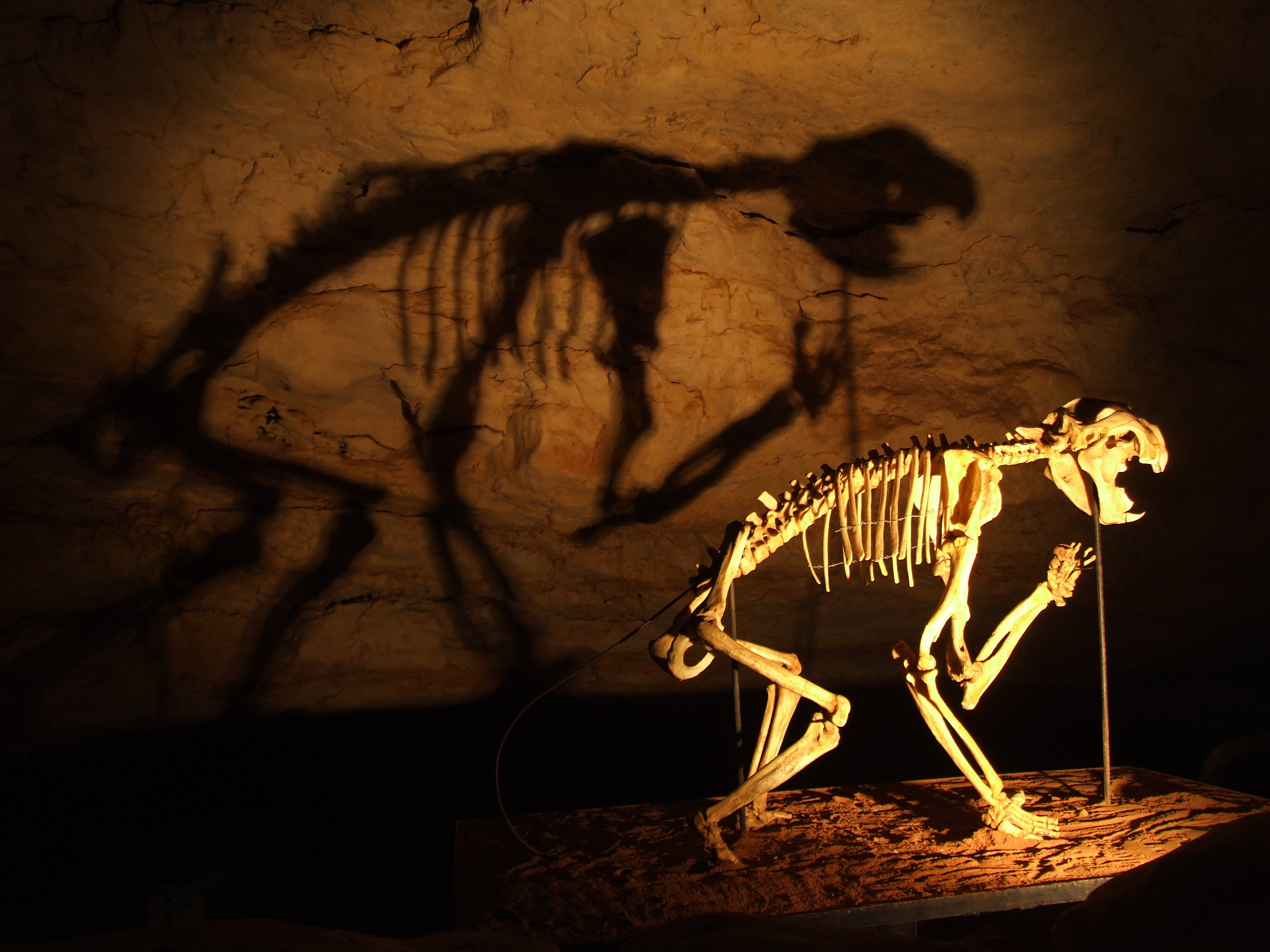
"Their ranks have included creatures as bizarre as the Argentinean pouched sabretooth, which sported monstrous, self-sharpening canine teeth that extended almost back into its braincase, and Australia’s own marsupial lion (Thyalcoleo carnifex, a skeleton of which is pictured above), which had teeth like bolt-cutters and the muscle power to match.”

“It seems likely that the diversity in skull shape among marsupial carnivores reflects a diversity in lifestyle that once was quite comparable to that of placentals,” says Dr Wroe, an expert in mammalian carnivore evolution. “Our results reinforce my own conclusion that the lack of marsupial predators in the world today has more to do with bad luck than bad genes.”

Thursday, 11 November 2010

Thylacoleo roadkill in NSW?


Paul Clacher has an interesting relatively new Thylacoleo sighting on his website - the proverbial dead animal beside the highway. Sadly no one ever seems to stop and take photos or collect carcasses!

20100807 - Pearson's Lookout (NSW) Sighting - December 2008 around 4:00 pm Reported 07/08/2010

Subject: Thylacoleo sighting

In December 2008, I was travelling south on the Castlereagh Hwy near Pearson's Lookout between the towns of Capertee and Ilford on the way back to Sydney after an overnight delivery trip through Orange, Dubbo and Mudgee in an 8 tonne rigid truck. No bonnet so I have unobscured vision. This is on the edge of the Capertee Valley and is about 900 - 1000 metres asl. The dropoff to the LHS (east) is steep to the valley. Late in the afternoon, say around 4.00 pm and about 200m south past the lookout, I noticed 2 X roadkill's on the southbound side just on the shoulder of the road.

Doing about 80km/h, I had a 5 or 6 second look at a small dead roo and something else. The markings on the torso of the other animal were dark brown / black and the main colour was tan. The markings made me look closer and the carcass was intact. The ears were rounded, the head was stout and like a lion cub and the front paws were huge in comparison to it's body size. The back paws and tail were obscured because of the position it landed in after being run over. (probably feeding on the small roo). My first thoughts were of a small lion, but the dark marking's threw me. It was a thick set animal about 500 - 600mm long. For the rest of the trip to Sydney (2.75 hrs) I couldn't stop wondering what this thing was, and having told the story to several people, I still couldn't come up with a logical explanation.

The story in today's Daily Telegraph regarding the Blue Mountains Panther made me check out for more info on the net regarding Australian big cat's / feral's, and my wife and I came across your page and pics of the Thylacoleo model at the Mt Isa Riversleigh Fossil Centre. This is what I believe to be the same animal, however it may have been juvenile due to it's proportions. If this was an Australian Marsupial Lion, believed to be extinct for how many years, how many similar species are out there that are belived to be mythical? The abundance of roos and wallabies in this area is phenomenal, so a foodsource for a carnivorous predator to thrive in the Capertee Valley is probably salubrious.

As I was driving on a log book, I couldn't stop as I would have ran over my driving hours, and didn't really consider the possible importance of the sighting. In hindsight, I wish I had turned around and stopped at the lookout and walked down to have a better look and at least taken photo's or thrown the carcass on the truck for an expert to identify.

Author / Witness - Jennifer
Reported Saturday 07/08/2010 - 4:16 pm

Thursday, 5 August 2010

Quoll numbers dropping in TAS


Eastern quoll numbers are declining in Tasmania, and scientists are worried.
The eastern quoll is a carnivorous marsupial and is sometimes known as a native cat.
Scientists predicted quoll numbers would rise as the Tasmanian devil population was decimated by the facial tumour disease.
But spotlighting survey work has shown numbers have fallen by half.
http://www.abc.net.au/news/stories/2010/07/16/2955349.htm

Wednesday, 28 July 2010

A lion in the Outback?


During the compilation of the opus that is Australian Big Cats: An Unnatural History of Panthers,authors Michael Williams and Rebecca Lang were handed lots of intriguing video footage - and possibly one of the most puzzling was that of what appears to be a lioness roaming the Northern territory Outback.
'Shot' by NT resident Jan Donovan, this still from the footage (which featured this week on the front page of the Northern Territory News) could lend weight to the notion feral exotic cats are running around in Australia's wilderness.
You might recall the case of the recently shot pygmy hippo in the Top End, which appears to have been an escapee from a private zoo.
What do you think?
We'd love to hear your thoughts - and if you have a photograph or video footage, we'd be happy to have a look and venture an opinion.
http://www.ntnews.com.au/article/2010/07/28/167481_ntnews.html

Tuesday, 20 July 2010

CFZers in the news again (shameless, really...)

Book on big cat research released

REGION - Eight years of research has gone into the production of the newly released book Australian Big Cats - An Unnatural History of Panthers, by Michael Williams and Rebecca Lang.

Writer/photographer Michael Williams and journalist Rebecca Lang have travelled all over Australia interviewing farmers, hunters, hikers and ordinary Australians investigating sightings, unexplained stock deaths and looking into the history books to gather information for the book.
Their travels have also brought them to the Ararat and Grampians region in their quest for evidence.
The presence of big cats in the Australian bush is one of the country's biggest mysteries and for many years there has been talk of sightings.
''There has been evidence of big cats in Victoria since the 1870s,'' Mr Williams said.
This evidence is a mixture of rich folklore, sightings and video evidence.
''In putting the book together, we have spent eight years researching and travelling around Victoria, New South Wales, South Australia and Queensland collecting reports, photos, video, scat and hair samples,'' he said.
''We want to prove the case that it's not just folklore, that these are valid reports.
''We want to prove the that evidence is overwhelming, that there is some mystery animal in Australia.''
The book is available online australianbigcats.com.au or through PO Box 5 Hazelbrooke 2779 NSW. The cost is $35 plus $15 postage.
http://www.araratadvertiser.com.au/news/local/news/general/book-on-big-cat-research-released/1889837.aspx

LinkWithin

Related Posts with Thumbnails

Recommended Reading