RESEARCHERS believe they may be on the verge of a breakthrough in the fight to save the Tasmanian devil from a deadly plague that is threatening the species with extinction.The unlikely would-be saviour of the world's largest marsupial carnivore is an unassuming devil named Cedric. In a development described as "the most exciting" in the five-year quest to halt devil facial tumour disease (DFTD), Cedric has shown an immune response to the unique communicable cancer.
Thursday, 10 April 2008
Cure for Tassie Devil?
Nicholas Cage loves his thylacines
"It would be a wonderful thing if they could find a thylacine," says Nicolas Cage, on set at the Melbourne Museum, who requested his photo be taken in front of the Tasmanian tiger. Cage is in Melbourne to film Knowing.
Extinct NZ South Island kokako spotted
March 2008. Alec Milne, an amateur ornithologist from Golden Bay, in the Nelson region at the top of the South Island, has reported to the New Zealand Department of Conservation that he has recently heard what he believes was the call of the South Island kokako at the head of the Cobb Valley in Kahurangi National Park, near Nelson. In 2005 Mr Milne saw a bird fitting the description of the South Island kokako in the same area.
http://www.wildlifeextra.com/kokako-sighting823.html
Yowie captured on film?
Glen Innes researcher Paul Compton captured these intriguing images on a movement-triggered trail camera in NSW Australia.
Wednesday, 12 March 2008
History Channel in Search of British Big Cats
The History Channel will be in search for evidence of British Big Cats as part of their 'Monster Quest' series, and will be filming at the end of March, beginning of April.
The search is on for the evidence, video footage, casts, photographs recordings, eye-witness accounts.
Have you seen a big cat in the British countryside, more importantly have you any evidence?
A search for a suitable location, on land with frequent sightings is also being sought for two nights filming. Big Cats in Britain press release.
Can you help. Big cats are reported everyday from somewhere in Britain, yet the hard evidence to support these black cats is virtually non-existent. People are obviously seeing something, but what. Can you help clear up the mystery?
Mark Fraser is collating the evidence, please contact him on 07940 016972, or email at bigcatsinbritain@btinternet.com or visit the website at www.bigcatsinbritain.org
Big Cats in Britain (BCIB) is the only group in Britain dedicated on a daily basis to finding out the answers to the big cat mystery. We have a core of experts that we can call upon, including scientists, zoologists, professional trackers, and police officers.
There is no such thing as a black puma, and black leopards are relatively rare in their country of origin. People in the UK are seeing something, but what? We need that evidence.
Thursday, 28 February 2008
Saturday, 9 February 2008
new thylacine report
MICHAEL STEDMAN
February 10, 2008 12:00am
TASMANIAN tiger sighting in Victoria has reignited the theory that the species may have been introduced to the mainland before it became extinct in this state.
Victorian farmer Harry Cook owns a property bordering the Otway Ranges south of Melbourne.Late last year he was with a mate inspecting crop damage caused by rabbits when they spotted three wedge-tailed eagles circling the paddock.
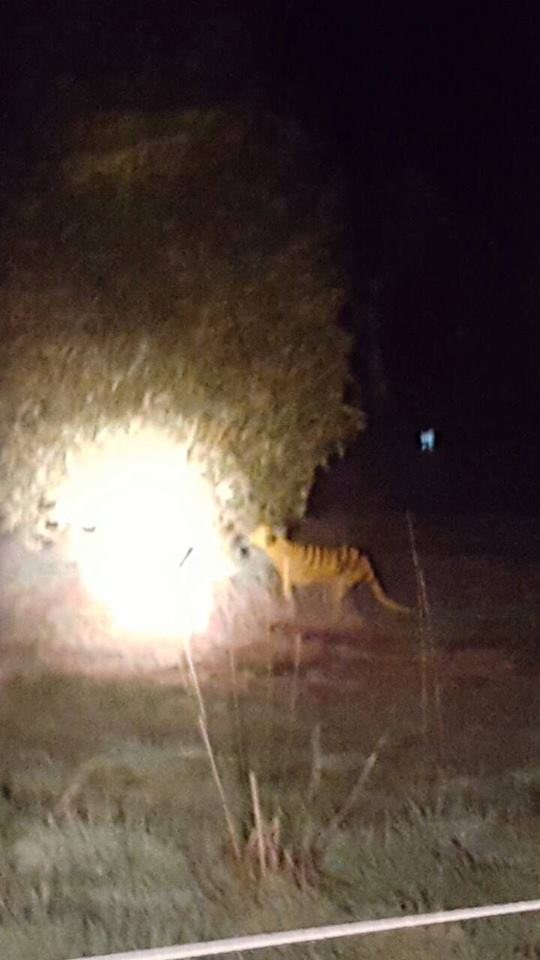
"They were circling over an animal -- we got within 12 foot of it. It was about the size of a large dog with a very long tail that was sticking straight up in the air as if it was fending off the wedgies," Mr Cook said.
"There were white stripes on its chest and it had a boofy head with round ears and the side of the muzzle was white."
He copped a lot of flak for reporting the peculiar sight, but not because no one believed him.
"Farmers around here told me I had broken the code of silence -- that they had seen things too, but as soon as it is reported all the townies come with their rifles trying to shoot it."
Mr Cook is not alone in experiencing such a sighting.
A former engineer, who did not want to be named, said he saw a dog-like animal in his headlights near Torquay in May 2006.
He described it in minute detail, from its slender body and fluid movements to the prison bar "salt and pepper" coloured stripes on its flanks.
"I can guarantee you there is a feral animal of some sort out there with short hair and stripes on the side; if someone says that description matches a tiger than I would say it is a tiger," he said.
Amateur researcher (name removed)has logged eight recent sightings near Geelong, in a triangle between Anglesea, Torquay and Freshwater Creek.
In November 1998 he videotaped what he claims was a thylacine in East Gippsland. The grainy footage can be found on YouTube.
Mr (name removed) has a theory that tigers were introduced to Wilsons Promontory between 1910 and 1915.During that time the park's committee of management had a policy of stocking the national park with endangered species including kangaroos, tiger quolls and birds.
"The timing is interesting because there are no records of tiger sightings until after 1912," Mr (name removed) said.
"The tiger still had a reputation as a stock killer so the last thing the committee would want to do is publicise it for fear farmers would go and shoot them, so that could be one reason why it was kept quiet."
Local wildlife biologist and thylacine guru Nick Mooney had heard the theory before and said it didn't wash.
"There is no evidence whatsoever beyond a vague conspiracy. There were some animals released at Wilsons Promontory but tigers were not on the list," he said.
He and other independent experts have examined Mr (name removed) footage and believe it to be a mangy fox carrying a rabbit. Most mainland sightings could similarly be dismissed as stray dogs, foxes or even illusions, because the last fossil record of thylacines on mainland Australia date back to 1000 years before white settlement.
But Mr Mooney, who works in the Tasmanian Government's wildlife management branch, is by no means a sceptic about the tiger's continued existence: "I have always said it is possible -- not probable, but possible."
He still receives at least two "credible" Tasmanian sightings a year.
"I got a call the other day from two shooters near Cradle Mountain who had to have seen a thylacine, or they are lying," Mr Mooney said.
"They were probably spotlighting illegally so there doesn't appear to be a motive for them to lie.
"The location was perfect and their description faultless."